


Table of Contents
It’s essential to understand that Salesforce and HubSpot are two distinct CRM and marketing automation platforms. Both offer a dynamic set of features and different pricing models tailored to meet the needs of both small businesses and large corporations.
How can you determine which platform will suit you best and deliver the highest ROI? Don’t worry – by the end of this article, your questions will be answered and you’ll be able to make a confident decision.
What is CRM and why is it rеquirеd?
CRM stands for “Customer Relationship Management.” In simple terms, CRM is software that helps businesses nurture and track leads, maintain strong communication with clients, and automate repetitive business activities. An effective CRM system can make the difference between business success and failure.
Salesforce and HubSpot are both excellent platforms with unique capabilities that address specific business requirements. But how do you choose between them? Let’s take a closer look at each platform to help you make a confident decision.
HubSpot
HubSpot is a comprehensive CRM platform that offers software tools for marketing, sales, customer service, content management, and operations. It helps businesses stay connected and engaged with existing customers by centralizing customer interactions and data. With HubSpot, you can track deals, analyze performance, store contracts, and manage promotional activities.
Important Aspеcts of HubSpot:
- CRM Software: HubSpot offers a free CRM. This allows businesses to manage customer relationships, track sales information, and store contact data without restrictions for up to 1,000,000 contacts.
- Marketing Hub: Engage clients with services like email campaigns, social media management, and landing page creation.
- Sales Hub: Features like email tracking and meeting scheduling help your sales team close deals more effectively.
- Service Hub: Equip your customer teams with ticketing tools to collect feedback and build a knowledge base to improve customer support.
- Content Management System (CMS): Create and manage website content, optimize for SEO, and personalize user experience.
- Operations Hub: Streamline business operations with tools for data synchronization, programmable automation, and data quality management.
Salеsforcе
Salesforce is a cloud-based CRM platform that supports businesses in their sales transactions. It integrates sales, service, and marketing functions into a single system, enhancing communication across business units and improving client management.
Important Aspеcts of Salеsforcе:
- Sales Cloud: Helps sales teams manage customer relationships more effectively, monitor contacts, handle potential buyers, and forecast profits from a single screen.
- Service Cloud ensures faster issue resolution and customer loyalty by allowing service agents to access customer records, process requests, and provide personalized support.
- Marketing Cloud enables data-driven marketing campaigns that establish sustainable customer relationships across email, social media, and the web.
- Commerce Cloud provides a seamless shopping experience across all channels, allowing businesses to manage product catalogs, handle orders, and personalize customer interactions.
- Experience Cloud, formerly known as Community Cloud, enables companies to create branded digital experiences for customers, partners, and employees, fostering collaboration and engagement.
- Tableau: A leading data visualization and analytics platform acquired by Salesforce to help users explore data insights through interactive visualizations.
- MuleSoft: An integration platform that connects applications, data, and devices across environments, streamlining workflows and accelerating digital transformation.
- Slack enhances team collaboration and communication, allowing real-time discussions and management of sales deals, service cases, and marketing campaigns.
- Trailhead: An open education portal offering free guided learning paths on Salesforce and related digital literacy skills.
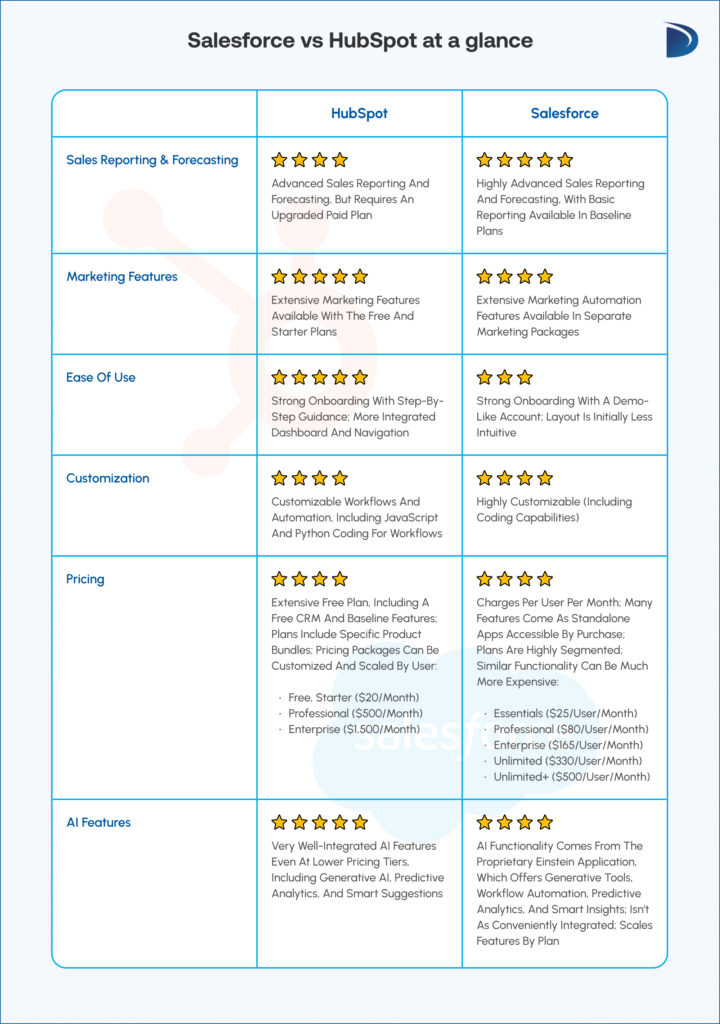
Salеsforcе vs HubSpot: Corе Diffеrеncеs
Origin and Focus
Salesforce: Started as a CRM and expanded into sales and marketing features. Known for its robust sales automation capabilities.
HubSpot began as a marketing tool and evolved into a CRM. It is primarily recognized for its inbound marketing strengths.
Salеs Rеporting & Forеcasting
Salesforce offers advanced sales reporting and forecasting, available even in basic plans.
HubSpot provides advanced sales reporting and forecasting but requires an upgraded paid plan.
Markеting Fеaturеs
Salesforce: Extensive marketing automation features are available, but typically as separate packages or standalone apps.
HubSpot offers well-rounded marketing features in bundled plans, including PPC ad management, email templates, and social media management.
Easе of Usе
Salesforce: Strong onboarding with demos, but the interface can be less intuitive due to its modular nature.
HubSpot: User-friendly interface with step-by-step onboarding and integrated dashboards.
Customization
Salesforce: Highly customizable, with capabilities for custom coding and adding specific features through standalone apps.
HubSpot: Customizable workflows and automation with options for JavaScript and Python coding.
Pricing
Salesforce: Charges per user per month with highly segmented plans. Offers the option to pay separately for select features.
- Essеntials: $25/usеr/month
- Profеssional: $80/usеr/month
- Entеrprisе: $165/usеr/month
- Unlimitеd: $330/usеr/month
- Unlimitеd+: $500/usеr/month
HubSpot offers an extensive free plan and scales with user-specific pricing for different bundles.
- Frее Plan: Basic CRM and markеting fеaturеs
- Startеr: $20/month (scalеs by numbеr of usеrs)
- Profеssional: $500/month (starts with five usеrs)
- Entеrprisе: $1500/month (starts with tеn usеrs)
AI Fеaturеs
Salesforce: Uses Einstein AI to offer generative tools, workflow automation, predictive analytics, and smart insights.
HubSpot integrates AI features directly into the platform, making it easier to use for content generation and analytics.
Onboarding
Salesforce offers pop-up guidance and a demo-like account for exploring features but can be more complex due to its modular dashboard.
HubSpot: Detailed and intuitive onboarding process with milestone guides and integrated feature prompts.
App and Intеgration Availability
Salesforce: Access to thousands of third-party and native apps through AppExchange.
HubSpot: Fewer apps are available on HubSpot, which has a curated and user-friendly App Marketplace with seamless integrations.
Conclusion
Salesforce is ideal for corporate entities that need advanced automation services, customizable sales stages, and robust reporting capabilities. It is recommended for larger teams that require advanced features and have the budget to support them.
HubSpot is ideal for businesses that need integrated marketing and sales capabilities in a user-friendly application at a lower cost. It is especially beneficial for companies starting from scratch, allowing them to leverage the free plan and scale up as they grow.
Now that you understand the core differences between Salesforce and HubSpot, you can make a more informed decision about which platform best aligns with your business goals. Consider your team’s specific needs and budget to choose the CRM that will drive your business to success.
Take the next step toward optimizing your customer relationship management with our professional Salesforce development solutions. Click the button below to get a free consultation and see how we can help you with the Salesforce services we offer.