

Table of Contents
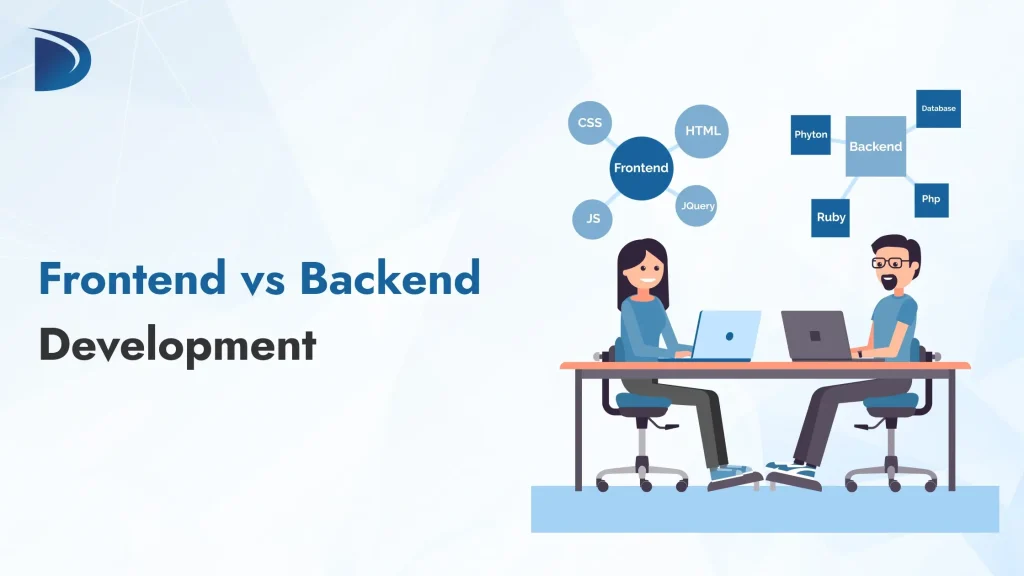
When people say “frontend” or “backend,” they’re talking about two halves of the same application:
- Frontend → everything users see, click, read, and interact with.
- Backend → the behind-the-scenes systems that store data, run logic, authenticate users, and power the app.
Choosing which path to learn or which roles to hire depends on interest:
Design & UX (Frontend) vs systems, APIs & data (Backend).
Frontend vs backend development represent one of the most important distinctions in technology. The frontend shapes the user experience, while the backend manages data, security, and performance.
This guide explains both sides in simple terms, compares the most in-demand tools, covers market demand, salaries, learning roadmaps, backend languages, future trends, and hiring advice, making it a comprehensive reference for developers and businesses.
What Frontend Developers Do?
Frontend developers create the visual and interactive elements of websites and web applications. Our frontend development services bring your design vision to life by building seamless, responsive user interfaces.
Key Responsibilities
- Convert UI/UX designs into responsive layouts (HTML, CSS, JS)
- Build reusable components and client-side logic
- Handle SPA/SSR routing, state management
- Improve accessibility (WCAG) and performance
- Integrate with backend APIs (REST/GraphQL)
- Optimize Lighthouse scores, animations, transitions
Frontend Tools & Frameworks
Frontend tools and frameworks help developers create fast, interactive, and visually appealing user interfaces. This ecosystem evolves rapidly, but a few tools consistently dominate because of their performance, flexibility, and strong community support. These leading frontend technologies include:
- React (industry standard)
- Vue.js
- Angular
- Svelte
- Solid.js
- Qwik
- Astro (popular for content-heavy sites)
- TypeScript (must-have skill)
- Build tools: Vite, Webpack, ESBuild
- Design tools: Figma, Framer
Who Should Choose Frontend?
Choose frontend if you enjoy:
- Visual design
- User interactions
- Animations, layout systems
- Making products feel fast and seamless
What Backend Developers Do?
Backend developers design server-side logic, databases, authentication, and infrastructure that power digital products. Our backend development services focus on building robust, scalable systems that efficiently manage complex data and user interactions.
Core Backend Responsibilities
- Build and design APIs
- Manage logic, validation, and permissions
- Choose, design & optimize databases (SQL/NoSQL)
- Implement authentication (JWT, OAuth)
- Ensure security, scaling, and high uptime
- Integrate third-party services (payments, AI APIs)
- Deploy systems using Docker, CI/CD, Kubernetes, or serverless
Popular Backend Frameworks:
Backend frameworks provide the core structure for building fast, secure, and scalable server-side applications. They streamline development with built-in libraries, strong security features, and easy database and API integration. Choosing the right backend framework ensures your application runs efficiently and scales as user demand grows.
Popular backend frameworks include:
- Node.js / Express / NestJS
- Python / Django / Flask / FastAPI
- Java / Spring Boot
- Go (Golang) / Gin / Fiber
- Rust / Actix Web / Axum
- PHP / Laravel
- .NET / C#
Deep Dive: Backend Languages
Below is a comprehensive overview of the most commonly used backend languages, their strengths, frameworks, and best use cases.
JavaScript (Node.js & TypeScript)
Why it is popular: One language for both frontend and backend. Ideal for real-time applications such as notifications, chat, and sockets.
Strengths
- Fast development cycle
- Massive npm ecosystem
- Great for I/O-heavy workloads
- Excellent for microservices
Common frameworks
- Express.js
- NestJS
- Fastify
- Koa
- Hapi
Best for
- Real-time systems (chat, gaming)
- API backends
- Microservices
- Startups or rapid iteration projects
Python
Python is readable, beginner-friendly, and ideal for data-intensive or AI-driven products.
Strengths
- Fast to develop
- Huge ecosystem
- Best support for AI/ML workflows
- Great for automation
Best Frameworks
- Django
- Flask
- FastAPI
Best for
- AI/ML backends
- APIs and dashboards
- Prototypes/MVPs
- Data-heavy systems
Java & Kotlin (JVM)
Java and Kotlin (JVM) are core enterprise languages used by banking, fintech, SaaS platforms, and large-scale systems.
Strengths
- Scalability & reliability
- Mature cloud and microservice ecosystem
- Strong community
- Works for mission-critical workloads
Frameworks
- Spring Boot
- Micronaut
- Hibernate (ORM)
Best for
- Enterprise platforms
- Complex business logic
- High uptime systems
C# / .NET
C# and .NET are well-suited for enterprise applications, especially on Windows or Azure.
Strengths
- High performance
- Strong typing
- Ideal for corporate environments
- Mature tooling
Best for
- Enterprise-grade APIs
- Internal company tools
- Microsoft stack products
Go (Golang)
Go (Golang) is designed for speed, concurrency, and cloud-native architecture.
Strengths
- Single binary deployments
- Very low memory usage
- Superb concurrency (goroutines)
- Excellent for microservices
Frameworks
- Standard library (net/http)
- Gin
- Echo
- Fiber
Best for
- Distributed systems
- High-traffic APIs
- DevOps tools
- Scalable microservices
Rust
Rust is the fastest-growing backend language for performance-critical and secure services.
Strengths
- Memory safety
- High performance (C++ level)
- Reliable concurrency
- Zero-cost abstractions
Frameworks
- Actix Web
- Axum
- Rocket
Best for
- High-performance APIs
- Security-sensitive systems
- Low-latency services
- Edge computing
PHP & Ruby
PHP and Ruby are still widely used for content-heavy websites and small to mid-size applications.
Strengths
- Simple hosting, low cost
- Excellent for CMS or CRUD-heavy apps
- Mature frameworks (Laravel, Rails)
Best for
- Blogs & CMS (WordPress)
- E-commerce (WooCommerce, Shopify integrations)
- Quick MVPs
Frontend vs Backend: Technical Comparison
| Area | Frontend | Backend |
|---|---|---|
| Focus | UI, UX, visuals | Logic, data, systems |
| Core languages | HTML, CSS, JS/TS | Python, JS/Node, Java, Go, Rust, PHP |
| Performance metrics | Load time, responsiveness | Latency, throughput, uptime |
| Tools | Figma, React/Vue, Vite | Databases, Docker, CI/CD |
| Output | User-interface | APIs, databases, servers |
Full-Stack Development
Full-stack developers work across both frontend & backend.
Full-stack means:
- Strong in React / Vue / Next.js
- Familiar with Node.js or Python
- Able to deploy with serverless, Docker, or managed cloud services
- Comfortable integrating third-party APIs
Best for:
- Startups
- Freelancers
- Small product teams
Market Demand & Salary Snapshot
India (Approximate Ranges):
- Frontend Developer: ₹6–12 LPA
- Backend Developer: ₹5–15 LPA
- Full-Stack Developer: ₹7–18 LPA
USA (Approximate Ranges):
- Frontend: $75k–$120k
- Backend: $85k–$140k
- Full-Stack: $90k–$150k
Salary varies based on:
- Tech stack
- Cloud skills
- Performance optimization skills
- Region & remote opportunities
How to Choose: Frontend vs Backend vs Full-Stack
Ask yourself:
- Do I enjoy visuals, animations, layouts → Frontend
- Do I enjoy systems, logic, APIs → Backend
- Do I want end-to-end ownership → Full-Stack
Also consider:
- Frontend changes fast
- Backend requires deeper system understanding
- Full-stack gives flexibility but demands continuous learning
Learning Roadmaps (Beginner Friendly)
Frontend Roadmap
- HTML & CSS fundamentals
- Responsive Design, Flexbox, Grid
- JavaScript (ES6+)
- TypeScript
- One framework: React or Vue
- State management (Redux, Zustand, Pinia)
- Testing (Jest, Testing Library)
- Performance optimization & accessibility
Backend Roadmap
- Choose a language: Node.js or Python (beginner-friendly)
- Learn HTTP, REST, JSON
- Database fundamentals: SQL + NoSQL
- Frameworks (Express, Django, etc.)
- Authentication, JWT, OAuth
- Caching (Redis), queues (RabbitMQ)
- Docker, CI/CD
- Cloud basics (AWS, GCP, Azure)
Full-Stack Roadmap
- Combine both paths
- Learn deployment pipelines
- Learn how to connect frontend + backend securely
How to Choose the Best Backend Language (Checklist)?
- What skills does your team already have?
- Is your app I/O-heavy? → Node, Go
- Is it CPU-heavy? → Go, Rust, Java
- Is the speed of development important? → Python, Node
- Is long-term maintainability key? → Java, Go, C#
- Do you expect enterprise-level scaling? → Java, Go
- Do you need ML or AI? → Python
- Is the cost of hosting a concern? → PHP, Go
Practical Stack Recommendations
| Project Type | Best Tech Stack |
|---|---|
| MVP / Startup Prototype | Node.js + Express OR Python + FastAPI |
| Real-Time App / Chat / Live Updates | Node.js + Socket.io |
| Data-heavy / AI-driven | Python + Django/FastAPI |
| Cloud-native Microservices | Go |
| Enterprise System | Java/Kotlin + Spring Boot OR .NET |
| High-performance backend | Rust + Actix/Axum |
| Content-heavy or CMS site | PHP + Laravel / WordPress |
Hiring Tips for Businesses
- Hire for problem-solving, not only language syntax
- Review real projects, not LeetCode
- For small teams → hire full-stack
- For scaling teams → hire specialists
- Prioritize developers who understand:
- Testing
- Scaling
- CI/CD
- Cloud environments
Future Trends
- Edge frameworks (Qwik, Astro) reduce JS bundle size
- Composable architectures (MACH) decouple frontend & backend
- AI-assisted coding accelerates development
- Serverless & microservices continue rising
- Rust & Go adoption grows for backend scaling
Conclusion
Both frontend and backend are essential in every field.
Choose:
- Frontend → if you love creating beautiful, interactive experiences
- Backend → if you enjoy logic, data, security, performance
- Full-stack → if you want to own entire products end-to-end